Through a series of programming extending beyond the boundaries of the University of Notre Dame’s South Bend campus, the Center for Citizenship & Constitutional Government (CCCG) is pioneering a national presence, fostering an intellectual home for faith and policy in the heart of the nation: Washington, D.C.

On April 7, 2026, CCCG Visiting Fellow Dr. Carl Trueman shared remarks at the Catholic Information Center (CIC) in Washington, D.C., on his newly published book, The Desecration of Man. Mary Eberstadt, the CIC’s Panula Chair in Christian Culture, moderated the meeting and introduced the book to the audience.
Trueman began by sharing how he first became interested in the intersection of policy and faith, which was through writing a letter to a school about transgender bathrooms. “The deeper, complex dimensions that came with that fascinated me,” he reflected. “I wanted to know more.”
He discussed the modern-day issue of disenchantment, saying that, “We used to value the importance of rituals; they used to be tradition.” He further explained that “Sexual activity, for example, has now become more recreational, losing its intimacy, meaning, and mystery.”
In Trueman's view, modern-day disenchantment leads to desecration among humans, and the solution is to return to the faith. “The Church is the true means of consecration.” Trueman summarized his solution in identifying three aspects: “Creed, Cult, and Code,” explaining that “the Creed is traditional Scripture, Cult is the community, and Code is the intent and accountability for actions.”
Trueman has reflected multiple times on his experience with the students at Notre Dame, noting the distinct atmosphere shaped by its Catholic student body. He wrapped up his session by relating it once more to his observations at Notre Dame. “Contrary to trends in the country, Notre Dame has an increase in young voices getting involved with the Church. They form a vibrant community, one where people hold each other accountable, but have the same goal of fulfilling the Lord’s promise.”
Trueman’s remarks serve as both a diagnosis of our disenchanted age and an introduction to a new, hopeful roadmap for the future. His conclusion is simple yet profound: the ultimate remedy for a desecrated world is a consecrated life. By embracing the Church’s ancient traditions and local community, we can reclaim the human dignity that modernity has worked so hard to obscure.

With dozens of Tocqueville Fellow alumni now living and working in the D.C. area, the CCCG hosted an alumni reunion on Wednesday, April 8, to give alumni the chance to reconnect with each other and the CCCG team.
Alumni were invited to attend a debate on Employment Division v. Smith between Prof. Muñoz and Georgetown Law Professor Stephanie Barclay, which was hosted by Catholic University of America's Federalist Society Chapter.
After the event, fifteen Tocqueville Fellow alumni, along with their spouses, gathered at a nearby pub for conversation and fellowship. The alumni who attended spanned ten years of fellowship classes, including the first Tocqueville Fellow, Kerry Hunt ‘14.
CCCG Associate Director Tyler Castle reflected, “As our ranks of alumni continue to grow, the CCCG plans to engage with this community on a more regular basis going forward. We're planning to host regional reunions like this one, an annual homecoming event, and other substantive and social events. A few alumni at the D.C. reception talked about starting a book club with alumni in the area, which is exactly the type of ongoing engagement we're hoping to initiate and support.”
The alumni make it known that they care about the Center not just through their words, but through their active presence and investment in the next generation. Castle described the new efforts, “Importantly, our alumni are also investing back into our work on campus. We've started connecting alumni with current fellows for discussions about career and vocational paths, and one of our alumni (Rogé Karma) helped us organize — and will also be moderating — one of our public events in the fall.”
By bridging the gap between past and present, alumni ensure the Center’s mission continues to evolve and thrive.
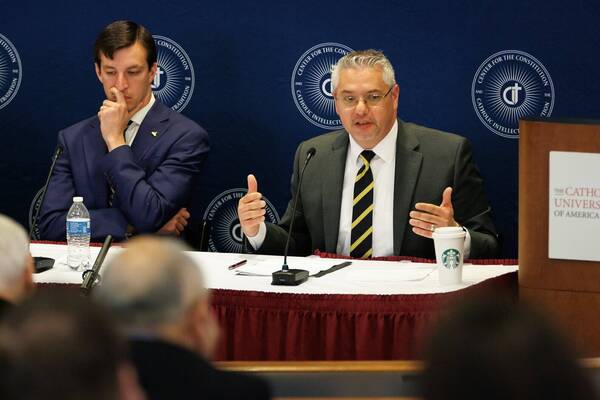
On Thursday, April 9, the CCCG, in partnership with The Catholic University of America (CUA) hosted a symposium, “Endowed by Their Creator: Catholicism, the Declaration of Independence, and the American Experiment at 250,” at the Columbus School of Law in D.C. This event brought together several high-profile scholars, including the center’s own Prof. Muñoz, Princeton University’s Robert P. George, and CUA’s Joel Alicea.
The symposium was divided into three panels, each composed of distinguished scholars whose area of expertise intersected with the symposium themes.
The first panel — The Declaration and the Catholic Intellectual Tradition — featured CUA's V. Bradley Lewis and D.C. Schindler in conversation with Muñoz. Michael Promisel of CUA’s Political Science department served as moderator.
Muñoz opened the discussion by aligning the American Revolution with the natural law tradition. He argued that “The principle of the consent of the governed is not just a slogan; it is a requirement of natural law.” He continued to explain, “When a government systematically violates the inherent rights of its people, a change in government is not only a right, but a moral necessity.”
Schindler disagreed with Muñoz, suggesting that the liberal order is crumbling because of the lack of robust, authoritative religious freedom. In Munoz’s rebuttal, however, he asserted that “We must be careful not to teach young Catholics that their national heritage is at odds with their faith; on the contrary, the American guarantee of religious liberty has allowed Catholicism to flourish here more than in almost any other modern nation.”
Between the morning and afternoon panels, the symposium featured a fireside chat over lunch. Robert George fielded questions posed by Brandon F. McGinley, following a video unveiling with special remarks recorded by Secretary of State Marco Rubio for symposium attendees.
George and McGinley’s discussion centered on the divine source of the Declaration’s “self-evident truths,” arguing that the American experiment is only possible because of a shared belief in a Creator who bestows unalienable rights. George traced the foundation of American equality back to the very beginning of the Bible, asserting that the concept of imago Dei is the only stable grounding for the claim that all men are created equal.
This exchange set a tone for the remainder of the symposium, combining the American founding with Catholic values and tradition. This momentum carried over into the second panel — “The Declaration and Constitutional Interpretation” — which shifted from philosophical foundations to the practical application of the law. This session featured Columbus School of Law’s Kevin Walsh, Judge Whitney Hermandorfer of the U.S. Court of Appeals for the Sixth Circuit, and Charlie Capps of Arizona State University, with Alicea serving as moderator.
Walsh argued that the Declaration of Independence is the “soul” of the American government, providing the moral foundation to understand the Constitution. “We cannot interpret the equal protection of the laws without first acknowledging the self-evident truth that we are created equal; the former is a legal guarantee, but the latter is the ontological reality that makes the law just.”
Capps built upon this, exploring whether modern originalism is sufficient when ignoring the natural law principles. He cautioned the audience that, “If originalism becomes a mere exercise in linguistic history without a moral core, it risks becoming a dead letter.”
The third and final panel — “Catholic Social Thought and the American Experiment” — featured panelists Russell Hittinger of CUA, Kenneth Grasso of Texas State University, and Ryan T. Anderson of the Ethics and Public Policy Center, moderated by CUA’s Sarah Gustafson.
This conversation wrapped up the day’s deliberations by bridging the gap between Catholic Social Teaching and the independence of a republican nation. Catholics have a past in America, and that is a fact that cannot be ignored. “Catholics have played a vital role in the success of our nation thus far,” said Anderson. “The future flourishing of America depends on a new generation of Catholics rising to the occasion.”
Anderson reflected on the session, “It's always an honor and a privilege to speak for Notre Dame, and what a treat to do so at Catholic University on the occasion of our nation's 250th anniversary.”
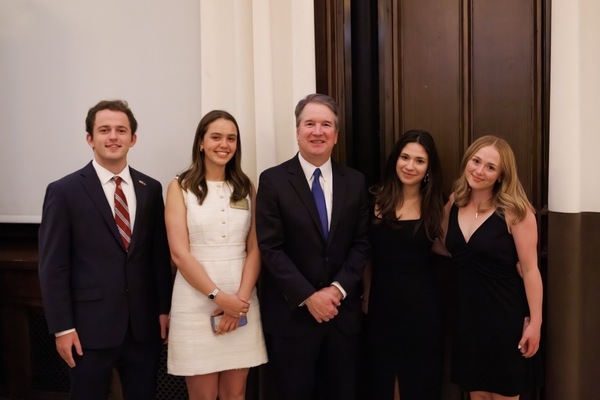
The evening concluded with a private dinner and fireside chat with Brett Kavanaugh, Associate Justice of the Supreme Court of the United States, in conversation with CUA’s Joel Alicea. Notre Dame and CUA students were invited to sit with Justice Kavanaugh during the meal, conversing about his path to the Court, his family, and Notre Dame football.
In his conversation with Alicea, Kavanaugh touched on the principles that have kept America resilient for the past 250 years, and how we must continue with that same commitment.
“I thought it was a tremendous opportunity to learn a bit more as to how a Supreme Court Justice thinks about interpreting the law,” Notre Dame student Matt Wich ('27) shared. “As a student studying in D.C. this semester, I enjoyed hearing Justice Kavanaugh reflect on topics we discussed in classes back at Notre Dame.”
The week’s engagements in Washington, D.C., represent more than just a series of successful programming; they mark a strategic milestone in the CCCG’s mission. By taking the lead in these national dialogues, the Center is redoubling its efforts to establish partnerships across higher education and bring to the fore critical conversations about the future of the American constitutional order, grounded in its signature hospitality.