During the spring semester of 2025, the Center for Citizenship & Constitutional Government hosted a colloquium for students titled “Catholicism, Feminism, and Politics.” The event was led by Drs. Margaret Freddoso and Gabrielle Girgis and brought students together for a series of discussions examining the compatibility of feminist ideals and the Catholic tradition’s understanding of the human person. Over these two days, students engaged with historical and contemporary readings addressing the meaning of sexual difference, the nature of marriage, and the legal and political claims of feminism. Furthermore, students continued to connect informally over meals and breaks throughout the weekend, deepening the conversations and forming new intellectual and personal connections.
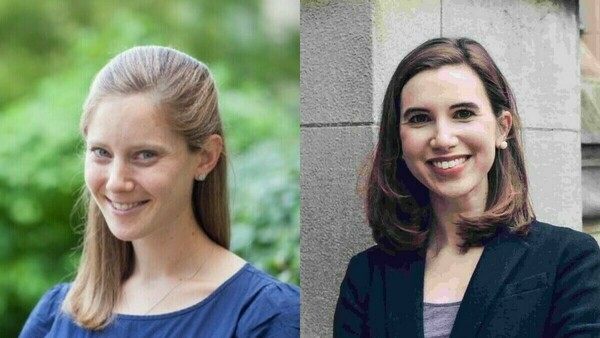
Freddoso holds a doctorate in theology from the University of Notre Dame and formerly was a Postdoctoral Research Fellow with the CCCG. She currently leads a research project on the harmony between Catholic theological order and modern economic findings. Girgis also is a former visiting scholar at the center with a doctorate in Politics from Princeton University. Her academic work focuses on religious liberty in American law, and she previously served as Managing Editor of the online journal Public Discourse.
The first session commenced with readings from Jean-Jacques Rousseau and Mary Wollstonecraft. Students examined Rousseau’s depiction of sexual difference, especially his contention that women’s virtue is tied to appearance and men’s to action. Wollstonecraft critiques such positions and rather proposes that genuine relationships between men and women ought to be friendships based on equality, especially in marriage, rather than relationships of dependence. Using these readings, students reflected on the limits of lust and passion in sustaining long-term relationships and explored how an understanding of friendship based on complementary natures could serve as a strong foundation for love between spouses.
As participant Angela Moreno (‘27) attested, “The tension between striving for equality and acknowledging inherent differences, particularly as explored through the contrasting views of Rousseau and Wollstonecraft, sparked considerable thought.”
The second session focused on first-wave feminism and its arguments for women’s equality, specifically through readings of texts by Sarah Grimké and Elizabeth Cady Stanton, alongside excerpts from Pope John Paul II’s Mulieris Dignitatem. From Stanton’s emphasis on individual sovereignty to Grimke’s vision of equal but distinct roles, the group analyzed the arguments of the first modern feminist movement and then contrasted them to John Paul II’s account of sexual complementarity and self-gift in marriage. The group debated whether gendered roles are best understood as the effects of sin or as elements of human nature, and they grappled with the question of whether Catholic anthropology prescribes fixed roles for men and women. The conversation illuminated the tensions between feminist critiques of dependent relationships between the sexes and Catholic emphasis on relational identity.
The third session turned to 20th- and 21st-century figures, such as Margaret Sanger and Erika Bachiochi. The discussion considered how arguments about rights and autonomy remained constant from earlier feminist thought in some texts, while evolving significantly in others. Students compared Sanger’s advocacy for birth control, which she framed as a means of liberating women from reproductive obligations, with Catholic critiques emphasizing the dignity and vocation of motherhood. The conversation interrogated the difference between feminist claims to self-determination and Catholic teachings that root human flourishing in the acceptance of physical and relational realities.
In the final session, Girgis and Freddoso guided student discussion through works by Edith Stein, Carrie Gress, Patrick Brown, and Anne-Marie Slaughter. These readings provided a range of perspectives on practical issues related to marriage, motherhood, and work. Stein’s theological framework described three states for men and women: the original order, where men and women are equal but distinct; the fallen order, which introduces hierarchical relationships; and the redeemed order, emphasizing a shared responsibility in the redemption of the sexes. Discussions considered how biological asymmetries could be respected without reducing women to merely maternal functions. Slaughter’s widely read essay, “Why Women Still Can’t Have It All,” prompted debate over whether current workplace structures adequately accommodate family life and what kinds of policy reforms might better support both men and women.
Emma Duffy, another participant, reflects on the value of these sessions, stating: “As a graduating senior, these discussions were really important to me. We were able to address practical problems that we will have to face once we leave the university.”
A similar appreciation on the practical relevance of these discussions is echoed by Dr. Freddoso, who adds: “What was most inspiring about the colloquium was the students’ genuine desire to pursue the truth about a contemporary issue in conversation with one another, and with the Catholic and feminist intellectual traditions, and their awareness that the truth that they sought actually mattered for how they will structure their adult lives.”
Dr. Girgis agreed, while also adding her excitement for continuing the conversation in a new academic setting: “It was especially fun to see things come together in the final sessions of each day, when we worked together to articulate points of convergence and disagreement between Catholicism and feminism. I'm looking forward to returning to these questions on a bigger scale in our fall course!”
That course, titled “Catholicism, Sex, Law, and Politics,” will be co-taught by Drs. Girgis and Freddoso this upcoming fall and has generated quite a bit of interest, revealing the compelling and timely nature of these topics.
Learn more about courses offered in the Constitutional Studies minor on our website.