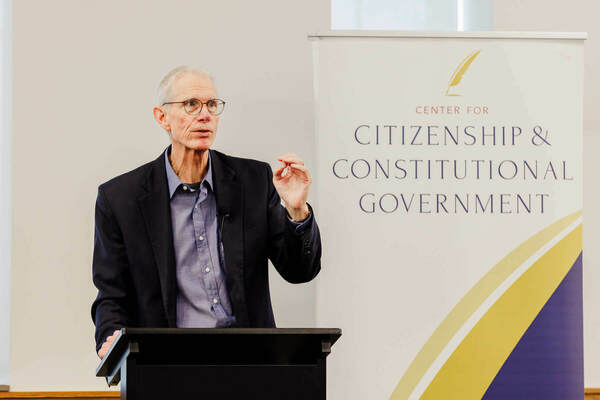
Josiah Ober, a professor of political science at Stanford University, delivered a lecture titled “The Civic Bargain: How Democracy Survives” on Notre Dame’s campus on April 24, 2025. At Stanford, Ober specializes in political science and has a secondary appointment in classics and a courtesy appointment in philosophy. In his research, he calls upon his experience in ancient and modern political theory and historical institutionalism to study questions surrounding rationality and democracy.
Ober began his lecture by announcing the problem he would be taking up in his talk: “Democracy here and elsewhere in the world is not doing as well as we’d hope.” This statement led him to the question of how to restore what he calls “the civic bargain,” which is also the focus of his recent book published in 2023 that bears the same title as his lecture.
Ober’s first step in his lecture was to identify the primary factor in the decline of American democracy, ultimately identifying “political polarization.” He claims that in polarization’s most extreme form, it can lead to a “Schmittian moment,” referring to the Nazi party member and 20th-century German political theorist Carl Schmitt’s conception of “friend-enemy” relations. Ober further explained Schmitt’s notion of the friend-enemy distinction: “The friends and enemy relationship [leads one to] see politics as existential conflict between hostile factions.”
Ober also highlighted that “political theology,” another one of Schmitt’s lenses for understanding politics, causes one to think “politics is about ‘good versus evil.’” Ober explained that Schmitt's concepts reduce politics to an understanding of who your enemies and friends are, bearing striking similarities to political rhetoric that he sees today. He lamented that such thinking “turns politics into very high-stakes contests,” which ultimately leads to politics being thought of as a “zero-sum game” with winners and losers.
Ober closed this portion of his talk by warning that Schmitt’s understanding of politics, which is seemingly becoming more relevant amid contemporary political polarization, is premised on the possibility of “physical killing and existential negation of the enemy.” He emphasized that the idea of “zero tolerance with those who you fundamentally disagree with” is becoming more prevalent today, “raising the stakes of politics” and bringing our society closer to comporting with Schmitt’s understanding of politics.
After expounding on Schmitt’s thought to potentially understand how democracies die, he then turned to the main preoccupation he addressed in his new book: “How do democracies survive?” Ober’s answer is simple: through civic bargaining.

The core argument of his book, as he recounted it, is that “long-lasting democracies that are successful over time are predicated explicitly not on the friend-enemy distinction, or zero sum contests between hostile factions, but rather on bargaining.” He described the concept of civic bargaining as the process in which two sides bargain for a “share of some good” to get the highest payoff for both sides. He contended that civic bargaining is not a new concept; it can be seen throughout history in self-governed societies such as ancient Athens, Republican Rome, Great Britain’s constitutional monarchy, and in America. The pattern of these societies demonstrates the ultimate civic bargain in which “we the people establish our own rules for organizing the civic space.”
Ober cited the American Constitution as a prime example of a civic bargain, as it was not fully regarded as perfect by the framers but was still embraced as “the best available bargain” to ensure that America could govern itself in its own best interests without resorting to an all-powerful “political boss.”
Although Ober argued the United States already has a civic bargain in place in its constitutional system, Ober quoted Benjamin Franklin’s famous statement that America will be “a republic if you can keep it” to warn of the need to actively preserve the civic bargain in the present day. He described the process the framers used to achieve the goals of the Constitution as a model for saving democracy today: “They negotiated and did so in good faith because they treated each other as civic friends rather than as Schmittian enemies.”
Civic friendship and civic education are key to Ober’s argument for civic bargaining, and he called upon universities to educate their students on these topics. He emphasized the need for everyone to receive civic education because “we as citizens share basic freedoms [and] basic equality, [so] we ought to have equal influence.” He expressed his regret that, while civic education is prioritized at elite institutions like Notre Dame and Stanford, it is not a part of all universities’ curriculum.
Audience member and Tocqueville Fellow Molly Foote asked Ober after his lecture, “Is there a constitutive way to help ensure people who aren’t a part of the elite educational practice know their duties?” Ober responded by emphasizing that civic education should also not just be limited to universities, as the duty to educate one another should be deeply internalized by all.
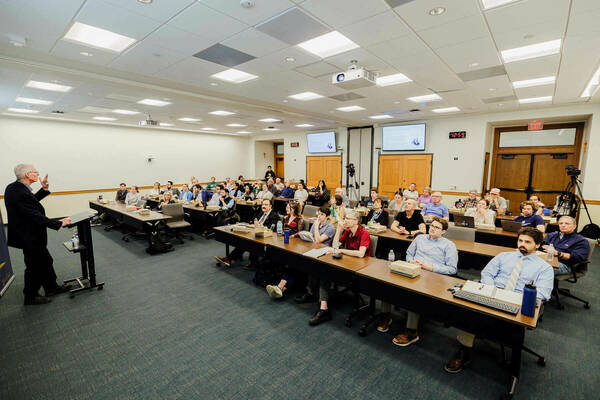
Ober closed by acknowledging that our democracy is and will continue to be imperfect, but in order to preserve what we do have, civic bargaining is necessary. He drove home that this bargain can only be upheld through civic friendship, civic education, and compromise, giving educational institutions a key role in securing the future of our democracy.
Catch up on Ober’s full remarks and our other programming by visiting our lecture library.