Christina Bambrick, the Filip Family Assistant Professor of Political Science at the University of Notre Dame, led a panel discussion with a number of her peers on August 27 on her recently published book Constitutionalizing the Private Sphere: A Comparative Inquiry (Cambridge Press 2025). Other panelists included Aníbal Pérez-Liñán, Director of the Kellogg Institute for International Studies and professor of political science and global affairs at Notre Dame; Leslie F. Goldstein, the Judge Hugh M. Morris Professor Emerita of the Department of Political Science at the University of Delaware; and Ran Hirschl, the David R. Cameron Distinguished Professor in Law and Politics at the University of Toronto.
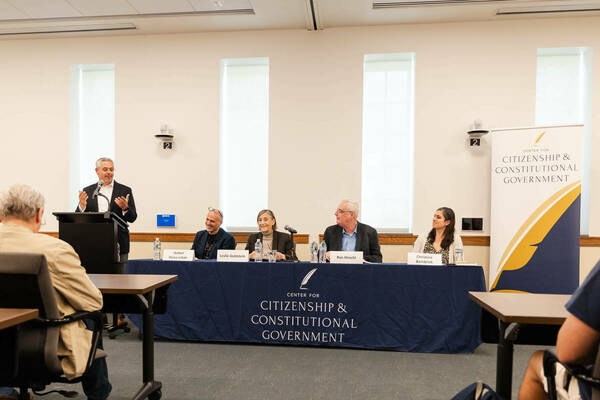
Bambrick opened by identifying the phenomenon explored in her book: the “extension of constitutional rights so that they create duties for private actors.” In legal terms, this is the horizontal application of rights, which contrasts with the traditional vertical model of constitutional law, where only the state is bound by constitutional obligations under the state action doctrine. The rationale for the vertical model is to preserve a private sphere free from constitutional burdens, which allows individuals and private entities to pursue their own projects without state-like duties. By contrast, horizontality seeks to hold private actors accountable for rights violations, aiming to address abuses wherever they arise.
The goal of the book, as Bambrick put it, is “to offer a theoretical lens through which to understand this [constitutional development] and to interpret discourses surrounding horizontal rights in actual constitutional politics.” Bambrick called horizontal rights “a republican vein in liberal constitutionalism.” She argued that horizontality creates greater parity between public and private spheres, reflecting a republican ideal of a polity committed to the common good. This model embodies the idea that citizens owe duties to one another, which expands constitutional obligations beyond the state.
To illustrate theory in practice, in her book, Bambrick examines the United States, India, Germany, South Africa, and the European Union to highlight their varied motivations and applications of horizontality. She concluded her opening remarks with two lessons: first, horizontal application is strengthened by turning to representative institutions that better express the people’s voice; and second, a polity’s embrace or rejection of horizontality shapes broader constitutional discourse
Subsequent reflections by the other panelists indicated praise for Bambrick’s deep comparative legal analysis and the usefulness and originality of her approach. Pérez-Liñán questioned the interpretive aspect of Bambrick’s method and suggested that perhaps a normative motivation was in place for undertaking such a project. Goldstein offered a historical accounting of various court rulings, including Marsh v Alabama and Jones v Alfred H. Mayer Company, that underscores republican values in horizontal rights. Goldstein claimed that the United States fits more into Bambrick’s analysis than she gives it credit for. Hirschl praised the book as an “exemplar of comparative constitutional inquiry for a political scientist” but requested more clarification on Bambrick’s notion of the “common good.” These questions and additional considerations, as the panelists suggested, could be undertaken and examined in another book.
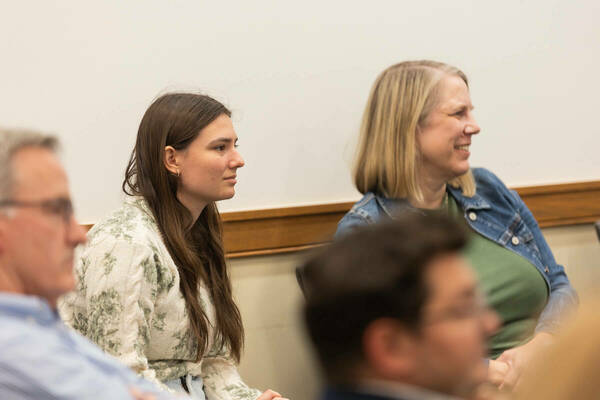
Packed into a standing-room-only classroom in Jenkins-Nanovic Hall, the diverse audience of faculty, undergraduate and graduate students, and local community members of Notre Dame, found Bambrick’s arguments compelling and engaging. Annabel Werhle, an undergraduate majoring in the Program of Liberal Studies, remarked that, “Coming to the talk unversed in comparative constitutional law, I was impressed by how accessible and fascinating Professor Bambrick made the complexity of her subject.” Werhle praised the other panelists’ contributions and appreciated the “combination of critique and praise for Bambrick’s work,” which “helped provide a well-balanced and interdisciplinary view of the subject.”
David Campbell, the Packey J. Dee Professor of American Democracy and an audience member at the discussion, likened Bambrick’s work to gymnastics. Campbell said, “Professor Bambrick’s work has a high degree of difficulty: combining the study of multiple constitutions with political theory, while also writing for empirically oriented social scientists.” Despite this challenge, Campbell assesses that Bambrick “has done it with aplomb–incisive, path-breaking, thought-provoking.” He remarked that “If we gave out medals, she would definitely earn gold.”
The full recording of Prof. Bambrick's book event can be viewed on our YouTube channel.
Stay tuned for additional programming this fall by checking out our events page.