In honor of Constitution Day, the Center for Citizenship and Constitutional Government hosted a review of this past year’s busy and consequential term for the Supreme Court of the United States. Rick Garnett, the Paul J. Schierl Professor of Law, and Derek Muller, Professor of Law, addressed a packed lecture hall on Friday, September 18, analyzing several key cases from the 2025-2026 term.
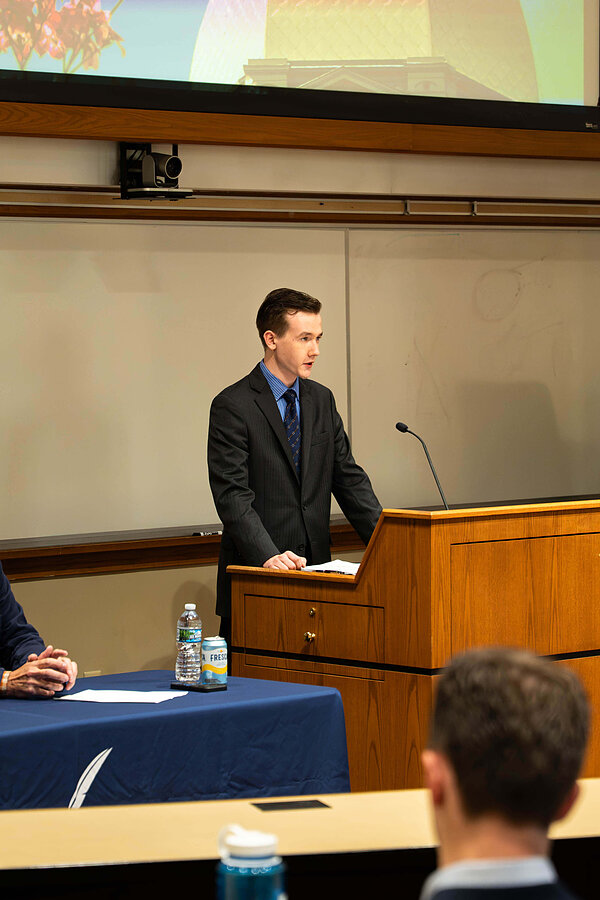
Before the panelists began, the CCCG’s Professor Donald Stelluto contextualized the topic around Constitution Day, highlighting the importance of legal education and the American public’s fascination over time with its highest court. Following an introduction by Tocqueville Fellow Kevin Bizily ‘28, Professors Garnett and Muller began their presentation in similar fashion, emphasizing the need for the public to be “informed, literate consumer[s] of news and information about the Supreme Court.”
Professor Garnett provided four tips for understanding how the Supreme Court truly thinks about cases and issues. First, the Court “decides legal questions, it doesn’t pick parties.” Contrary to how the media covers Supreme Court issues, the Court does not decide cases based on the identity of the relevant parties; instead, they evaluate the parties’ arguments on a particular issue, and choose how best to interpret the issue. Selecting winners between conflicting groups like business and labor is “not the way they think about it, and it’s not the way you should think about it either,” said Professor Garnett.
“A second thing to remember is that the Court does a lot of things besides decide [sic] cases,” Garnett noted. “A big thing the Supreme Court does is decide not to take cases.” He went on to explain that out of the approximately 4200 petitions the Court received this past term, it only selected around 60. This is a little over a 1% selection rate. Garnett also urged the audience to keep in mind that when the Supreme Court declines to take a case, it “really hasn't taken the case,” that is, by turning a case down, the Court has not ruled in either party’s favor.
Third, Garnett debunked misconceptions about the Court’s interim docket, sometimes known as the “shadow docket.” The Court uses this procedure to expedite pressing cases, so a decision can be rendered in a timely manner. He further explained that despite the mystique of the name, everything on this docket is public.
Finally, Garnett cleared up another common misconception about the Court. “What it primarily does is not resolve hot-button social issues on partisan lines,” he explained. Instead, the majority of its cases are procedural in nature, dealing with “geeky” aspects of the law. The Court is also more bipartisan than commonly thought. “[The] majority of cases are unanimous, and only a quarter are partisan 6-3 rulings.” These recommendations helped the audience better interpret the cases that the professors next explained.

Professor Muller, whose research specializes in federalism and elections, highlighted several high profile cases including Louisiana v. Callais, the latest in a long line of cases dealing with racial equality in elections. Muller outlined the historical precedents of this issue, noting that their complexity makes it difficult for legislatures to adhere to the principles of race-neutrality and minority representation, a dilemma he compared to the mythological Scylla and Charybdis. In Callais, the Supreme Court decided that Louisiana’s redistricting amounted to unconstitutional racial gerrymandering, effectively establishing “race neutrality as the [primary] principle behind the Fourteenth and Fifteenth Amendments.” Muller argued that this shift will change “how we think about congressional districts.”
The professors’ discussion of election-related cases, including Callais and the campaign finance case NRSC v. FEC, was well-timed. As Ella York ‘29 put it, “this is obviously becoming a huge talking point with midterms coming up.” The relevance of these cases underscores the importance of the public staying informed on judicial news.
As an expert on First Amendment law, Professor Garnett explained Chiles v. Salazar, a free speech case regarding a Colorado conversion therapy ban. He highlighted the nuances of the case, since it involved legal concepts like viewpoint regulation of speech, regulation of professional speech, and regulation of conduct. Ultimately, the Court sided with Chiles, affirming that “this Supreme Court…is very speech-protective as a general matter.”

Garnett also discussed Landor v. Louisiana Department of Corrections, which dealt with a state inmate whose religious freedom rights had been violated. This case was interesting because of its surprising outcome. “Everyone expect[ed] the Supreme Court would rule for the inmate, including me,” said Garnett. However, the Court ruled in favor of the state, since the case ended up hinging on federalism, not religious freedom. This case demonstrated that the Court can be unpredictable, even for experts.
Audience questions addressed several other prominent cases, including Trump v. Cook, which dealt with the President’s ability to fire Federal Reserve Governors, and Learning Resources, Inc. v. Trump and V.O.S. Selections, Inc. v. Trump, a pair of cases challenging the legality of tariffs. Jack Freeburg ‘27 appreciated the professors’ comprehensive analyses, saying “it was cool that they took a deeper look into more nuanced cases that I didn’t follow at all.”
The professors finished with a brief outlook for the coming Supreme Court term. The Court will hear a consequential citizenship case, RNC v. Mi Familia Vota, which, according to Professor Muller, is “a case 26 years in the [making].” The Court will also decide on St. Mary Catholic Parish v. Roy, a religious liberty case on which the Notre Dame Law School’s religious liberty clinic has filed an amicus brief. Only time can tell the outcomes of these cases, but the professors’ analyses certainly demonstrated that the upcoming term will be one to follow.
To view the full recording of Garnett and Muller's remarks, as well as past event archives, visit our lecture library.
To stay up to date with additional CCCG programming, subscribe to our email list.