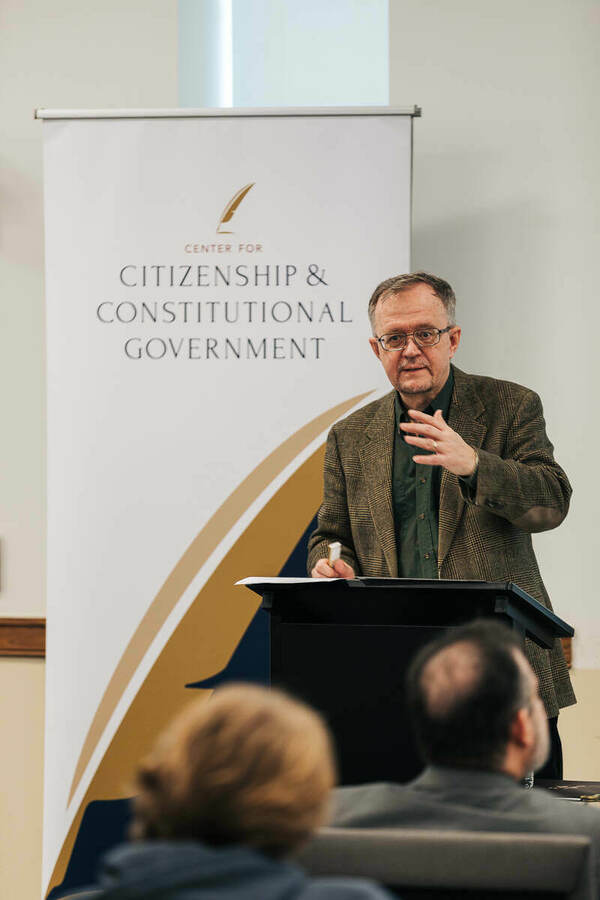
Aurelian Craiutu, Professor and Chair of the Department of Political Science at Indiana University, Bloomington, delivered a lecture at the invitation of the Center for Citizenship and Constitutional Government on February 13, 2025, exploring the concept of political moderation. Craiutu, whose recent book Why Not Moderation? Letters to Young Radicals was published by Cambridge University Press, argued that moderation is a vital yet often misunderstood political virtue. His lecture examined why moderation has an "image problem" in contemporary politics, how it has been historically understood, and whether it can serve as a viable solution to modern political polarization.
Craiutu opened his lecture by posing what he called the "million-dollar question"—who is afraid of moderation? He noted that in today’s political climate, where the stakes of every election feel existential and rhetoric is increasingly extreme, moderates are an “endangered species,” as moderation is often dismissed as “weakness.” Citing Barry Goldwater’s famous declaration—“Extremism in the defense of liberty is no vice, moderation in the pursuit of justice is no virtue”—he highlighted how moderation is often seen as “uninspiring and indecisive” compared to ideologies centered on ideas of justice or liberty. Consequently, unlike radical positions, moderation rarely “makes headlines” or rallies mass political movements.
At the same time, Craiutu warned that the absence of moderation has dangerous consequences. He argued that “echo chambers” and political tribalism—fueled by social media and sensationalist news—have created an environment where politicians gain power by refusing to compromise. Rather than seeking common ground, many leaders today adopt an uncompromising "my way or the highway" approach, reinforcing divisions rather than resolving them.
Craiutu emphasized that moderation is not a single doctrine but a broad tradition of thought that “transcends political ideology.” He described it as an "archipelago," composed of diverse philosophical contributions rather than a cohesive, identifiable ideology. He explained that it is necessary to “highlight the faces of moderation,” meaning that moderation must be studied alongside concepts such as prudence, justice, and extremism.
Historically, Craiutu contended, moderation has been a central theme in political and theological thought. He traced its origins to classical philosophers like Aristotle, who defined moderation as a "mean between extremes," and Cicero, who emphasized its role in statesmanship. He also noted its importance in early modern political theory, citing figures such as Michel de Montaigne, Blaise Pascal, and the 17th-century English writer Joseph Hall, who described moderation as the "silent string that runs through the pearl chain of all virtues."
The concept gained renewed prominence in the 18th century as a counterweight to “fanaticism.” Enlightenment thinkers such as Montesquieu and Voltaire saw moderation as essential to preventing tyranny and fostering tolerance. Montesquieu, in The Spirit of the Laws, famously wrote, “The spirit of moderation should be that of the legislator,” linking moderation to the complexity of constitutional governance.
Craiutu also examined the role of moderation in the American founding. He pointed out that the Federalist Papers frequently invoked moderation as a guiding principle. Figures such as George Washington and John Adams championed moderation as a necessary safeguard against the dangers of factionalism and concentrated power. Adams warned that “without moderation, every man in power becomes a ravenous beast of prey.”
Beyond its role as a personal virtue, Craiutu also highlighted how moderation is embedded in American political institutions. He argued that constitutional mechanisms such as bicameralism, the separation of powers, the presidential veto, and federalism all serve to moderate political decision-making. These institutional checks, he contended, embody an often overlooked dimension of moderation that is “crucial to keeping a stable republic.”
Addressing the contemporary political landscape, Craiutu acknowledged that moderates face significant challenges. He noted that the number of moderates in the U.S. Senate has dramatically declined over the past few decades, with “fewer than five moderates remaining in the chamber today.” The political center, he observed, often appears powerless in the face of polarization.

However, Craiutu also pointed to “reasons for optimism.” He cited initiatives such as Braver Angels and the American Exchange Project, which seek to foster dialogue across ideological divides. He suggested that, contrary to popular belief, “the middle may be far larger than you and I think” and efforts to rebuild a culture of political moderation could gain traction.
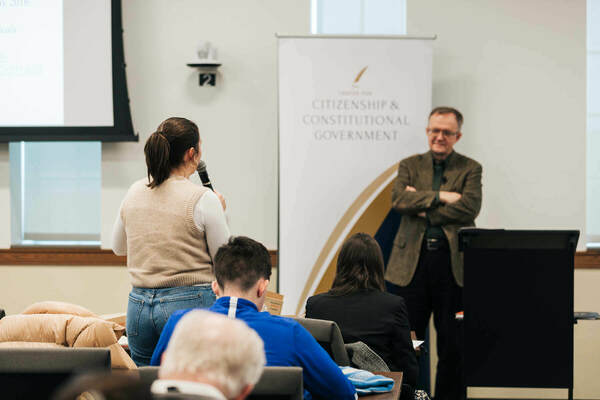
In response to student questions, Craiutu urged students to study history and learn from past thinkers, citing Seneca’s letter to Lucilius: “Look at the library, all of those people are dead, but they are there waiting to engage in a conversation with you.” He warned against ideological “purity tests” and the dangers of certainty in political life. He ultimately advised that a true moderate should resist believing that they know the truth and rather seek to “get closer to the truth” through conversations with opponents and maintaining an open mind.
Craiutu concluded with a provocative reimagining of President Donald Trump’s "MAGA" slogan, explaining that “moderation is a magnetic idea. Properly understood it’s a radical virtue and can offer us the new MAGA that we so badly need today: Make America Governable Again.”
Visit our lecture library to review Craiutu’s remarks in full and catch up on our past events.