
Daniel Mark, an Associate Professor of Political Science at Villanova University, delivered a lecture titled “The Nature of Law” at Notre Dame on April 1, 2025. At Villanova, Mark regularly teaches political theory, philosophy of law, American government, and politics and religion. Additionally, he has served as a member of the bipartisan U.S. Commission on International Religious Freedom and was elected Vice Chairman of the body last year. From 2017–18, he spent time as a visiting professor with the Center for Citizenship & Constitutional Government, during which time he worked on his book, The Nature of Law, published by University of Notre Dame Press in the autumn of 2024. In his lecture, Mark explored the core question of his book: “Is there an obligation to obey the law?”
Mark began his talk with a provocative thought experiment surrounding a traffic light. He asked his audience to imagine a driver on an abandoned road who approaches a red light. With good lighting, no other vehicles on the road, and a general absence of the considerations related to safety or the orderly flow of traffic, the driver is faced with a choice: stop or go. In this situation, Mark acknowledged but brushed aside the psychological and sociological questions of whether you would go or whether most people would go, instead focusing on the philosophical question at hand: “Do you have an obligation to stop at that light?”
He suggested that at first it seems like one has two obligations, one moral and the other legal. However, he re-emphasized that in this situation there is “no reason to obey the law other than the fact that it is the law,” as all the other considerations about why one would not run the light (e.g., safety, concern for the flow of traffic) do not apply. Thus, in this situation, there is “no inherent moral obligation to stop at a red signal” other than one which arises from the legal obligation. The collapse of what initially seemed like two obligations into one leads to a deeper question: “Does the authority of law depend on the reasons behind the law, or just the fact that it is the law?” In other words, does the moral authority of the law remain when the specific reasons for the law do not apply?
Mark’s answer to this question is that traffic laws—and all other sorts— “are absolutely rooted in morality, in principle, but the specifics are not rationally required” because their authority is derived from the reasons behind the legal system as a whole. Because the legal system exists for a good reason, i.e., to care for the common good, according to Mark, each individual law is morally binding, even when one may disagree with the reasons behind the law or think that they do not apply in a particular circumstance.
To further support his point, Mark addressed alternative answers to the question he posed, particularly those put forward by legal positivists, who subscribe to the view that laws can be identified without respect to normative criteria such as morality. Thinkers he labeled as the “older positivists” believe the law is defined by the provision of punishments for disobedience and habits of obedience, while British philosopher and influential legal theorist H.L.A Hart views laws as “rules based in social practice.”
Both conceptions of law, unlike Mark’s, avoid the question of the law’s moral authority and, rather, seek to better understand what defines law and how the obligation of obedience to the law works. Despite the general ascendancy of Hart’s thought in the field of legal philosophy, Mark finds a fatal flaw in his logic. Since Hart sees law as an obligation that has no grounding in reality and instead is rooted in “social practice,” Mark questions whether the obligation Hart speaks of is helpful for understanding when we ought to (or ought not to) follow what is apparently the law—a question that is particularly relevant when evaluating “evil” law systems, such as Nazi law, an example that is “uncontroversially unjust” yet in which one can “see the operation of law.”
Further criticizing Hart’s positions, Mark next took up Hart’s teaching that “people don’t relate to the law the way they relate to a mugger ... In that situation, you’re obliged to give the mugger your wallet, but you’re not obligated.” He appreciated Hart’s point that law is identified by the existence of an obligation, rather than the mere existence of a punishment and habit of obedience, as the older positivists argued. However, Hart’s contentment with merely describing law as obligatory through “an internal point of view” still leaves Mark unsatisfied, as “he cannot account for the sense of obligation that is now at the center of his theory.” He challenges Hart’s dismissal of morality, because even if society accepts a law through its social practice, Hart’s thought does not help one identify why (or consequently if) we should feel obliged to follow it.

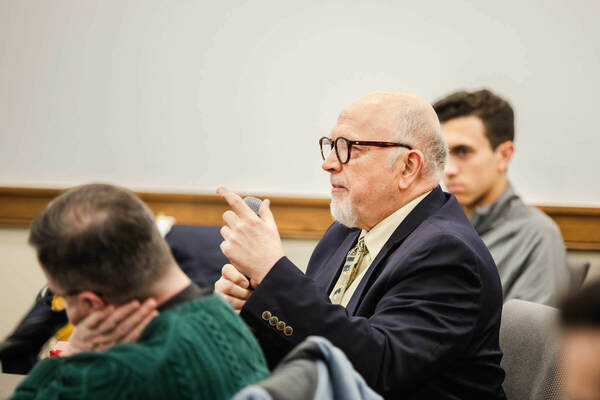
In the question-and-answer period following Mark’s lecture, audience member John Luke Hoonhout, a PhD student in Constitutional Studies and Political Theory, asked Mark, "What do you do when you have conflicting moral obligations?” In posing his question, Hoonhout referenced the concept of “civil disobedience” and Dr. Martin Luther King Jr.’s admonition that “an unjust law is no law at all.” In addressing the case of an unjust law, Mark responded that even an unjust law can have a moral obligation attached to it if it is part of a legal system that is “overall oriented to… the common good.” Mark argued that the content of the law cannot be independently evaluated to determine the moral obligation attached to the law, apart from the legal system of which it is a part. Hoonhout found Mark’s talk a “compelling case for abandoning some of the assumptions of contemporary legal theory and returning to a more classical understanding of the nature of law.” Reflecting further on the Mark’s response to his question and the lecture overall, Hoonhout continued, “Although I agree more with the classical position on this point, I found his overall thesis persuasive, and I think he provides a great example of a scholar who can speak to both an academic and a popular audience at the same time.”
Many other audience members found his theories compelling and engaging. Tocqueville Fellow Angela Moreno (‘27) had the opportunity to join him for breakfast and was particularly impacted by Mark’s idea that “the absence of agreement does not show absence of truth.” This prompted Moreno to “reflect on the deep connection between morality and law.” Moreno expanded, “Overall, this breakfast was one of the most engaging and memorable experiences I’ve had during my time in the fellowship program—Daniel’s passion for his work and his warm, charismatic presence created an environment where everyone felt genuinely welcome.”
To view Mark’s remarks and browse our other recordings, visit our lecture library.