
Rev. William R. Dailey, C.S.C., is a familiar presence on Notre Dame’s campus. Whether you encounter him as a professor, rector, or priest, it is hard to avoid “Fr. Bill,” as he is affectionately called by his students and colleagues, in at least one of his many roles at this university.
Originally from Warren, OH, Fr. Bill graduated from the University of Notre Dame with a Bachelors of Arts in Philosophy in 1994. Following graduation, Fr. Bill spent a year working as a lobbyist in Washington, DC. But he soon returned to Notre Dame in order to begin formation for the priesthood within the Congregation of Holy Cross (C.S.C.), graduating with a Masters of Divinity in 2000. In the years following his ordination in 2001, he worked as a priest and philosophy professor at the University of Portland until 2003, when he then attended Columbia Law School as a Harlan Fiske Stone Scholar, earning his J.D in 2006.
This additional detour away from the Notre Dame community did not last long, though. Fr. Bill returned to teach at Notre Dame Law School following a clerkship with Judge Diarmuid O’Scannlain of the U.S. Court of Appeals for the Ninth Circuit and a few years of practicing law in Washington, DC. Fr. Bill has been deeply involved with the Notre Dame community in a myriad of ways ever since this last return.
Currently he serves as the Rector of Graham Family Hall, which, via the community’s previous life as Pangborn Hall, is the same residence community into which Fr. Bill moved as a first-year student in 1990. Additionally, Fr. Bill teaches in the law school, and occasionally offers undergraduate courses through the Center for Citizenship & Constitutional Government’s Potenziani Minor in Constitutional Studies. He is teaching one such course this semester, titled “The Constitution and Criminal Justice.” In a conversation with the Center, Fr. Bill took a break from his busy teaching and ministry schedule to reflect upon the journey to his various roles at Notre Dame.
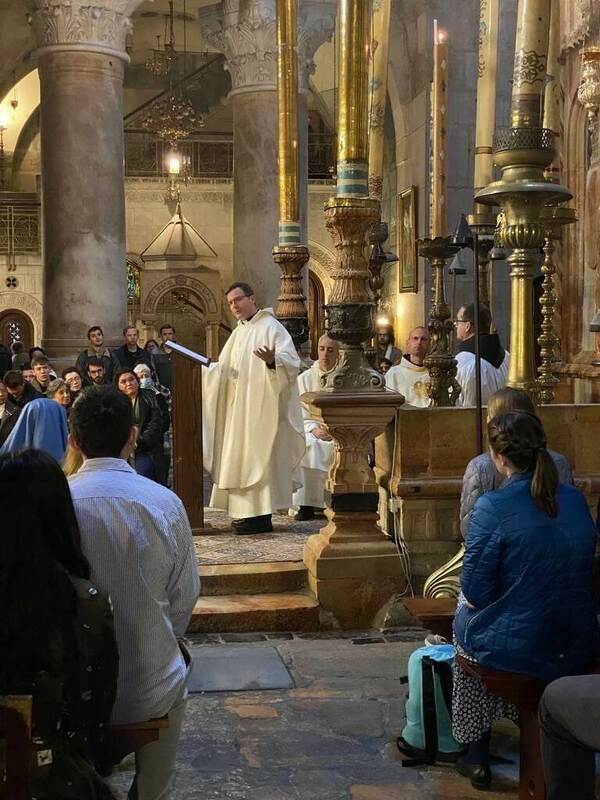
Fr. Bill began by looking back to the origins of what he views as his most important role at Notre Dame: that of a Holy Cross priest. Fr. Bill remembers that his vocational journey started as a young child, when he was shaped by his family’s active involvement in their parish and religious mentors in his life. He fondly recalls Father Joseph Malik, a priest from his home parish — “classic white hair, balding, Polish-American, loved to tell Polish jokes at his own expense” — as a positive role model in his life and for many others in the parish.
Despite Fr. Malik’s affirming influence, as Fr. Bill grew up, the priesthood didn't look like something he was capable of doing. That changed, however, when he came to Notre Dame. As an undergrad studying philosophy, his faith was strengthened and tested as he began to seriously grapple with the question, “Do I believe in God at all?” He shares that this journey “ultimately resulted in the deeping of my faith,” moving him to seriously consider the priesthood after graduation. Fr. Bill cites his opportunity to “see a different kind of priesthood, the involvement of young folks here, [and] the friendship the priests had with one another” as prime movers in “[bringing] back the sense of vocation” he had as a child.
As a C.S.C priest, Fr. Bill takes seriously the call of Holy Cross founder Fr. Basil Moreau to “be an educator in faith” — a mission that he sees as inseparable from his role as a teacher. Whether educating law students or undergraduates, Fr. Bill aims to teach in a way that “has people respecting one another's human dignity and thinking about their role in the world.” Tocqueville Fellow Mercedes Curran (‘27) affirms, "His professional experiences are demonstrative of the technical skills and attention of a great lawyer, but as a Holy Cross priest, his vocation leads him to place emphasis on understanding the logic and reason behind the arguments we look at.”
For example, when teaching about the Fourth Amendment in his Constitutional and Criminal Justice class, he highlights the difference between understanding the concept of “reasonable suspicion” and actually witnessing it in practice through showing his students footage of police executing a “Terry stop” (also known as a “stop and frisk”; the brief detention of a person based on law enforcement’s “reasonable suspicion” that he or she is involved in criminal activity). Fr. Bill hopes that this exercise will prevent his students from viewing issues of constitutional and criminal justice too abstractly and instead teach them to focus on the dignity of all persons affected by such issues. His students now view this experience as a “pivotal part of the class” and as a lesson “fundamental to understanding the dignity of persons and why learning about criminal justice is so important in our country,” said Curran.
Fr. Bill emphasizes that his mission to educate according to the call of Fr. Moreau does not end at the doors of his classroom. In his capacity as rector, Fr. Bill seeks to inculcate the same respect for human dignity and deep grappling with questions of faith that he strives to stimulate through his teaching. He does not hesitate to reach into his own diverse experience to help reach students in this regard. Two of Fr. Bill’s Graham Family Hall Resident Assistants are in his class as well, and student Liam Gibson (‘25) highlighted the consistency of his vocation in his roles as a professor, priest, and rector.
“Fr. Bill clearly mixes these roles in his homilies, which are among the best on campus. He is foremost a priest, standing and delivering a sermon from the front of the dorm chapel. The content is often intellectual, pointing to his role as professor. Finally, he applies the lessons of the readings to our lives in the dorm. He is a terrific example of the diverse means by which a priest can serve the Church.”
Fr. Bill serves as a valuable resource for his students and residents considering law school or the priesthood, offering guidance both academically and personally. He consistently shares insights from his own legal and ministerial education, takes time to explain high level concepts to residents in Graham Family Hall and his students, and regularly makes himself available to discuss their questions, hopes, and anxieties. Gibson recounts, “His door is often open so that residents or students can stop by for a conversation over a cup of coffee. Fr. Bill seeks to guide residents as they navigate college life, resolves interpersonal conflicts, and uses his authority to charitably correct residents as needed in the dorm, as he believes it should be home to a community which promotes the development of the entire person.”

Fr. Bill's presence undoubtedly affects students in many ways. While undergrad students may only have four years on Notre Dame’s campus, he leaves a lasting effect on his students and residents. He was described as a “professor who prioritizes teaching with integrity” and a “protector of the Constitution” by several students. In his class, students have said that they are moved to ask now, “Is this the state of the law?” but instead answer the question he asks his students weekly, “Should this be the state of the law?”
To learn more about the Potenziani Minor in Constitutional Studies, visit our website.