
The CCCG hosted Dr. Charles Kesler for a public lecture on campus titled “Natural Right and Political Right in the American Founding” on October 3rd, 2024. Dr. Kesler is the Dengler-Dykema Distinguished Professor of Government at Claremont McKenna College and acts as a leading voice in American political scholarship, specializing in American constitutionalism, political thought, and conservatism.
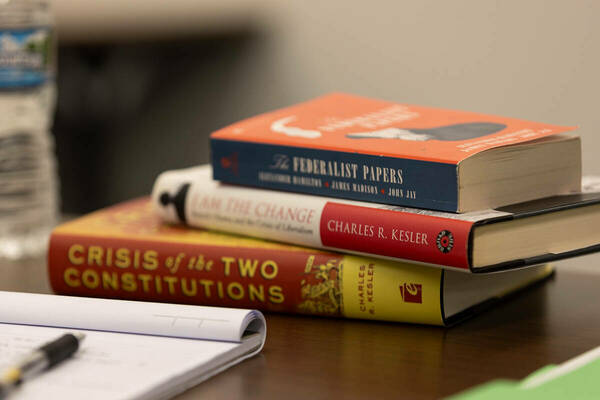
The edition of The Federalist Papers that he edited and provided an introduction for stands as the best-selling version in the nation. Additionally, Dr. Kesler has edited three other volumes and is the author of the critically acclaimed book I Am the Change: Barack Obama and the Crisis of Liberalism. His scholarly contributions earned him the prestigious Bradley Prize in 2018. He currently serves as the Editor of the Claremont Review of Books and as a Senior Fellow at the Claremont Institute for the Study of Statesmanship and Political Philosophy.
In his lecture, Dr. Kesler first explained how his experience in the editorial realm shaped the focus of his talk, which walked through much of the editing process of the Declaration of Independence that occurred in the Continental Congress. He went as far as to say that his experience in editing has given him “an occupational bias,” stating his belief that “it would be a better world if we had more and better editors.”
He observed a consistent decline in the prevalence of edited writing with the rise of the internet, stating that this has led to a more “anarchic” and “ugly” world. In opposition to contemporary trends, Dr. Kesler asserted the timeless importance of editing, stating that even the best authors need editors, including Thomas Jefferson when writing the Declaration of Independence.
Throughout his talk, Dr. Kesler revealed that some of the Declaration’s most famous phrases were not initially composed in the form in which we now know them; instead, they went through an extensive editing process, often to Jefferson’s dismay.
For instance, Dr. Kesler noted that Jefferson’s original draft of the Declaration of Independence began with the phrase, “We hold these truths to be sacred and undeniable,” rather than the now-famous lines, “We hold these truths to be self-evident.” Dr. Kesler pointed out that this change in the language surrounding one of the most well known sentences in American history is not merely superficial.
Unlike the longer phrase “sacred and undeniable,” Dr. Kesler argued that the word “self-evident” denotes a statement that is not simply obvious but rather also “an obvious truth that carries its own evidence in terms of its proposition.” Dr. Kesler held that understanding the significance of this word choice is crucial, as the coupling of the Declaration’s claim of human equality to an ancient category of logical certainty set the stage for the document's exploration of natural rights to which all humans are entitled.
The fact that this important change in wording was absent from Jefferson’s first draft serves as a compelling testament to the importance of editorial revision, according to Dr. Kesler. He went on to recount numerous examples of revisions made to the Declaration’s text during the three successive days of congressional deliberation on the document, noting that approximately a quarter of the text was ultimately omitted through editorial changes. Dr. Kesler humorously referred to this process as “perhaps the most successful exercise of group editing of all time.”
However, Jefferson did not share Dr. Kesler’s appreciative sentiment; he described these changes made to the Declaration as “mutilations.” Among the most significant edits were those related to the slave trade. In the Declaration’s original draft, Jefferson notably condemned the institution of slavery and the British king’s role in it, stating, “[The King] has waged a cruel war against human nature itself, violating its most sacred rights of life and liberty in the persons of distant people who never offended him.” Ultimately, this powerful denunciation of slavery was removed during the editorial process, as it was politically impracticable at the time of the Declaration’s signing.
Although Dr. Kesler held that the Jefferson’s strident critique of slavery follows undeniably from the Declaration’s statement of human equality and wished that such a passage could have been included at that point in American history, he nonetheless contended that the deletion of this passage–which Jefferson greatly resented–was yet another editorial success. Because America’s colonies played a more active role in the institution and perpetuation of slavery than Jefferson’s complaint let on (blaming it on the King), as well as due to Congress’s need to not alienate several of the rebelling colonies that still had substantial interests in the continuation of the slave trade, Dr. Kesler argues that the inclusion of such a passage would have been “a stretch” given the actual reality and have come off as a dishonest attempt at “virtue-signaling.”
After spending the greater part of his lecture exploring the edits made to the Declaration and their significance for the document’s overall meaning, Dr. Kesler concluded his lecture by arguing against the notion that the edits to the document were indicative of a broader disagreement about the fundamental principles of the Declaration within the Congress. But he did acknowledge the significantly different ways that two of the men most involved with the document’s creation–Jefferson and John Adams–looked upon the document nearly fifty years later, arguing that their divergent retrospective thoughts shed great light on the challenges facing the principles of the Declaration today.
Dr. Kesler spoke about how Jefferson, in his “Letter to Weightman,” expressed great optimism for the future of the principles that the Declaration asserted, hopefully pronouncing as he neared death that “all eyes are opened, or opening, to the rights of man.” Dr. Kesler immediately contrasted Jefferson’s rosy picture of what the Declaration initiated with John Adams reflection, written around the same time as Jefferson’s statement, that the still-youthful American experiment would form either “the brightest or blackest page” in the world’s history depending on “the use and abuse of those political institutions” set up by the Declaration.

Dr. Kesler finally suggested that Adams’ “sober prediction” that the “future would be very much like the past, open to use and abuse, virtue and vice, good government and misgovernment” was a helpful starting place for figuring out how the lofty principles of natural right laid out in the Declaration descend into partisan bickering, and thus also a helpful starting point for evaluating the Declaration.
This last portion of Dr. Kesler’s talk stuck out to Emma Duffy, a senior minoring in Constitutional Studies. Duffy said was very grateful for the opportunity to hear from Dr. Kesler, especially as his lecture supplements the topics of one of her classes. She continued, “My favorite part of the lecture was the contradicting statements that Adams and Jefferson made about the Declaration towards the end of their lives.”
Duffy elaborated: “I had only read Jefferson’s letter that had made the Declaration seem like a beacon of hope for the rest of the world. But, Adams’ [statement] was much more interesting. He was unsure of the success of the Declaration, and left the outcome to the future Americans. It was a reminder that we have to do our part to uphold the standards of the Declaration in modern, turbulent times.”
The full recording of Dr. Kesler's remarks can be viewed on our YouTube Channel. To stay in touch with the Center for Citizenship and Constitutional Government and be the first to know about upcoming events, subscribe to our mailing list here.