
The Center’s “spirit of encouraging thoughtfulness” helps first-years think about free speech, discussion leader discern future
During the Fall 2024 semester, I was fortunate enough to lead a colloquium that examined “Free Speech and the University” as part of my responsibilities as a Pre-Doctoral Research Affiliate withthe Center for Citizenship and Constitutional Government. The colloquium was much like any other weekend colloquia for which the Center has become well-known on campus: We met for four one-hour discussion sessions and two meals together to dive deeply into a complex and pertinent topic, guided by pre-assigned readings from some of the most thoughtful voices on the subject and spurred on by our collective enthusiasm to get to the bottom of the questions at hand.
But there were a couple of distinctive characteristics that made our meetings that weekend feel very different from any of the prior colloquia I had been a part of. First, most of the students sitting around the circle of desks were younger and less experienced than usual, a result of the fact that this was the first-ever colloquium specifically designed to include mostly first-years. These bright, young minds brought such high enthusiasm to the great questions of citizenship we were studying and were eager to take advantage of the opportunity this colloquium presented to them. Seeing them carefully engage with the difficult texts we were studying and with their peers was an amazing sight to behold.
The second reason why this colloquium felt so different from others in the past was, after years of participating in CCCG colloquia as a student, I now found myself on the “other side.” After years of relying on thoughtful faculty to guide me and my peers through the probative discussions that make up the standard colloquia experience, I now was the one with the responsibility of facilitating quality discussion and a thorough treatment of the readings before us.
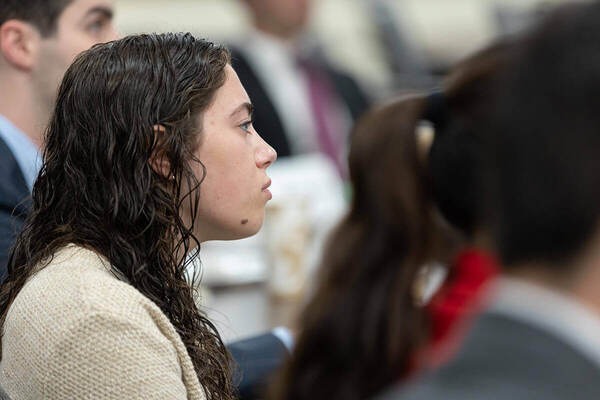
Taking on this new role was an opportunity that my time studying with the CCCG as an undergraduate had prepared me for and was precisely the sort of experience that my position as Pre-Doctoral Research Affiliate with the Center this year was meant to create for me. The chance to walk through these readings and lead discussion with such a talented and thoughtful group of students as those who had been selected for this colloquium was the perfect opportunity to take the next step as a student and scholar.
Poring over the feedback that the talented bunch of students who joined us that weekend provided me gave me a chance to reflect upon the experience I had leading the colloquium. I was happy that every student who responded to our post-colloquium survey would recommend it to their peers and felt better equipped to engage in (sometimes contentious) political discussions. One student noted how our group’s exercise in “thoroughly examining the arguments commonly used on both sides of the free speech issue” helped him realize “how nuanced the subject is and how to best connect diverse viewpoints to reach a conclusion that promotes justice and fairness for people with differing opinions.” Such powerful responses as this one and others encouraged me to reflect more deeply upon how the weekend had affected me.
The experience of leading the discussion rather than merely participating in it highlighted for me in a visceral way what the sort of discussion that takes place in colloquium is all about. As a student, even when one is most focused on finding truth in regard to some particular subject of interest, one is bound to feel some degree of ownership over the points and arguments that one advances. There is nothing wrong with this fact nor do students bear any blame for approaching discussion in this way: interlocutors need to be committed to what they are saying to ensure that the argument they are defending has its strongest possible case stated. A student’s sense of ownership over their points thus serves the interest of the whole group’s quest for truth.
But that same sense of ownership can often seemingly turn one into a partisan for a particular part of the truth, making one’s view narrow—not necessarily untrue, but narrow nonetheless. Conversely, the role of the discussion leader allows one to escape such narrowness by transferring one’s sense of ownership from a particular argument to the discussion as a whole. This change takes one away from direct contribution towards the communal search for truth that is proceeding in the seminar but imbues one with a sense of responsibility to ensure that such a search for truth proceeds well.

And, I found, when one is tasked with ensuring that a discussion proceeds well, one gives more thought and attention to what exactly it means for a discussion to go well. Instead of discussion being about how well you expressed your point or how convincing you were, one sees how the exercise of inquiry is about bringing each individual participant to a clearer state of mind and position than before he or she arrived. The fundamental importance of such colloquia is not located in its capacity to change people’s minds or to bring everyone to what may be a more correct position on the issue, but rather in its ability to help everyone involved think more clearly and to make the best possible argument for the position he or she is led to in their thinking. Thus, I found myself more concerned with ensuring each individual interlocutor left with a clearer view of the situation regarding free speech and its place on campus than with where we or I happened to land on the question. In short, leading the discussion helped me realize that the colloquium was as much about aiding the participants’ thinking about free speech as the questions surrounding free speech themselves.
It is fitting that the CCCG gave me the opportunity for this transformative experience, for I have come to see that what I learned leading the colloquium is at the center of what the CCCG does. Much of the Center’s programming is animated by the same spirit I took on in attempting to lead the colloquium: helping people, especially students, think more clearly about important issues of citizenship and constitutionalism, not simply in advancing any given viewpoint about those questions.
I have the Center’s commitment to this spirit of encouraging thoughtfulness to thank for providing me this opportunity in the first place. This colloquium, in addition to how it helped the student participants, gave me the chance to think more clearly about my own desire to lead students in the manner that a graduate education would prepare me to do as a teacher. The CCCG, in providing me this opportunity as a pre-doctoral fellow, did not seek to purely instill some particular ethic of teaching in my mind but led me to an experience that would help me to think more clearly about the issues at stake. Such an opportunity to approach the subject of my future carefully is of invaluable importance in my own life, and the provision of these opportunities to many others like me at Notre Dame—including that group of students I led in the colloquium—will someday improve the contribution we all make to the civic life of America.
To stay in touch with the Center for Citizenship and Constitutional Government, subscribe to our mailing list here.