Professor Sherif Girgis, a faculty fellow and friend of the Center for Citizenship & Constitutional Government, recently earned tenure and was promoted to full Professor at Notre Dame Law School. Girgis began his academic journey at Princeton University, earning his A.B. in philosophy in 2008. Following his time at Princeton, Girgis was named a Rhodes Scholar. During his time as a Rhodes Scholar in Oxford, he completed a B.Phil., also in philosophy. He then began both a doctoral degree in philosophy back at Princeton and a J.D. at Yale Law School. Upon graduation, he clerked for Tom Griffith, a judge on the D.C. Circuit Court of Appeals, and then at the Supreme Court with Justice Samuel Alito. After practicing law in the Washington area for a short period, Girgis found his way to Notre Dame in 2021 for both personal and professional reasons. As he teaches at Notre Dame, he continues to work towards completing his Ph.D.
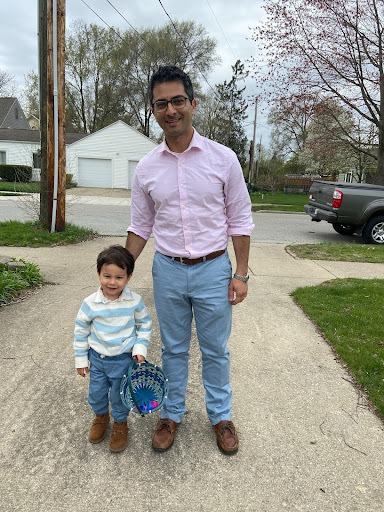
Girgis initially was drawn to Notre Dame by connections of his wife, Gabrielle, and her parents—a family of Notre Dame graduates. Yet, beyond personal connections, Girgis was attracted to the university’s combination of serious intellectual rigor and pursuit of truth within the Catholic tradition: “[This pursuit of truth] shapes both the feeling of the community here, …and the content of academic discussions. At other schools, you might be stuck arguing first principles with your colleagues all the time because they don't share your first principles. Whereas at Notre Dame, there will be some of that, but there will also be many people who share your broad outlines of your view of faith, morals, or vision of what law is for. And that allows you to probe more deeply disagreements about how to implement that broad vision. And that is a completely different set of questions.”
Concerning Girgis’ own work within constitutional theory, he praised the breadth of opportunities to engage with the brightest intellectuals in his field at Notre Dame adding, “We have lots of really fantastic people in those areas who think very rigorously and bring a different perspective than you find in much of the rest of the academy and that was also a big draw [to Notre Dame] as well.”
To Girgis, Notre Dame stands out as a distinct place where many scholars view their work more in terms of a vocation than is typical at many prestigious universities. When asked about his own approach to work as a vocation, he added, “At a natural level, that means that the purpose of your work, beyond whatever immediate, practical purposes it serves ... is about service. It's about helping other people to thrive in the ways that your gifts especially suit you to help them, and at a broader level, that service is encompassed in the broader goal of giving glory to God and doing what you think He wants you to do with the gifts that He gave you. And so that's about seeing where your talents, … other people's needs, and a sense of peace that you get after prayerful discernment intersect. And for me, that's in teaching and scholarship.”
Girgis’ view on his work as vocation is deeply rooted in his Catholic faith: “[I]t's not that there is a Catholic way to write a law review article or a Catholic way to write a legal brief, but there is a Catholic way to think about that work. There are virtues, moral and theological virtues, that you should bring to that work. Your Catholicism and your sense of personal vocation shapes what you do, because they give you the sense that God has a preference for what you do.”
Beyond his vocation as a legal scholar, Girgis embraces his primary vocation as husband and father of his three children. He noted, “I often tell my students that my priorities are God, Our Lady, my wife, my kids and then my students.” Girgis’ students nonetheless sing his praises as a professor who is deeply committed to the growth and development of his students.
Hadiah Mabry, Notre Dame Law School Class of 2025 graduate and incoming clerk on the Sixth Circuit Court of Appeals, wrote, “Prof. Girgis is one of the reasons I chose to come to Notre Dame. I read some of his scholarship while deciding whether law school was right for me, and I was inspired by the way in which he combined philosophy and legal theory while still taking his Catholic faith seriously.”
Veronica Maska, an incoming 3L, commented regarding Girgis’ unique approach to serious questions writing: “More than anyone else I have encountered in the classroom, Professor Girgis is gifted at presenting all positions in the strongest possible light. Despite his immense intellectual talents, he never belittles other people or their views and has a way of making you feel smarter after a conversation.”
These students of Girgis reiterated that he stands out among faculty because of his prioritization of his students, first and foremost, as persons. Mabry continued, “Prof. Girgis is a brilliant teacher. He is thoughtful, kind, and engaging, while still expecting the best from his students. He is also incredibly funny and down-to-earth, which was a bit of a surprise for a well-known legal scholar. He is always willing to take the time to explain a complex legal topic.” Maska agreed, adding “Professor Girigs is exceptionally generous with the time that he invests in students and in giving frequent talks at the law school. While many in the academy share their talents with the world through written scholarship, Professor Girigs models what it looks like to also intellectually invest at a personal level in the immediate law school community.”
Learn more about the center's faculty fellows on our website.