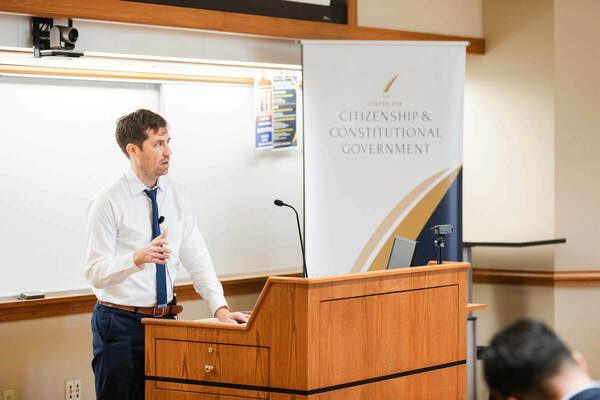
On Wednesday, March 26, Antón Barba-Kay, a Distinguished Fellow at the Center on Privacy and Technology at Georgetown University Law Center and Senior Fellow at the University of California, San Diego’s Institute for Practical Ethic delivered a lecture entitled “Regimes of Speech: The Politics of AI and the Fate of Liberal Democracy” for Notre Dame’s Center for Citizenship & Constitutional Government. In his lecture, Barba-Kay discussed the future of liberal democratic politics in our age of ongoing digitalization, a topic that he also took up in his recently published book A Web of Our Own Making.
Barba-Kay began his lecture by recounting a provocative question he had posed to a senior researcher at Microsoft: Is TikTok's ownership more momentous to the fate of American democracy than the mobbing of the capital on January 6, 2021 was? Somewhat surprisingly, Barba-Kay explained, the researcher he had spoken with confidently asserted that TikTok's ownership is more momentous because while the “latter [January 6] was a circumscribed event, the enforced sale of TikTok will put the eyeballs of 170 million American users under the control of one of the two or three bidders already wealthy enough to buy it.”
Barba-Kay went on to postulate that the fact that TikTok is so synonymous with the health and well-being of American democracy is itself a problem. “What have TikTok or our current digital environment as a whole to do with democracy?” Barba-Kay speculated, “‘Nothing much’ or ‘nothing good,’ at least, is what I'm going to argue today.”
Barba-Kay then began a discussion of the relationships between different forms of media and regime types. “The same media can accommodate all kinds of regimes,” he explained, “but there are nonetheless affinities and resonances at work, as the relationship between media and regime is not controlling or monocausal but directive, or teleological.” Thus, according to Barba-Kay, there are some forms of media that are more conducive to democratic regimes while there are some that are more abrasive to them.
In the current context, digital media is viewed as generally being a democratic force according to Barba-Kay. However, he asserted that the current forms of digital media actually erode democratic regimes by offering too much choice, murky forms of optimization, and intrinsically biased neutrality. The supposed freedom, efficiency, and neutrality of these digital media platforms create what Barba-Kay says is an illusion of them being unbiased arbiters of our digital media. But, in reality, these qualities have led to a “‘tech bro’ authoritarianism” according to Barba-Kay.
With conditions being what they are, Barba-Kay stated that “we find ourselves collectively at a place where two democratic trajectories diverge.” On one hand is “a project that primarily entails the zealous management, programming, and fine-tuning of our information environment such as to make most people's online engagement as reasonable and salutary as possible.” On the other hand, he identifies the second road as requiring us “to commit to the long-term projects of holistic, wholesale, and post-digital education in literacy, in acknowledgement that the actual project of fertilizing democracy is connected to the long-term disciplines of thought.”
In other words, Barba-Kay asserts that we must either fix our digital platforms by divesting them of the characteristics of “tech bro authoritarianism” or we will have to change our relationships to these platforms by returning to forms of education rooted in older forms of media, particularly “books.” The virtue of this latter road, according to Barba-Kay, is that this project is “about creating the conditions under which democratic deliberation, justification, and attention as habitual casts of minds might be possible.”
“My own answer about which road is best is obvious enough,” Barba-Kay concluded. “If a national discussion is not exactly possible now, I think that the seeds of one are still present in specific settings of people staked to thought in common, and if this educational program is not the most realistic option, I think it remains the most practical and harmonious with the latent hopes of a democracy that's still young and still to be achieved.”
Following Barba-Kay’s lecture, students felt emboldened to interact more meaningfully with the digital world. Tocqueville Fellow Lilian Jochmann (‘26) reflected that “Professor Barba-Kay’s lecture on the relationship between modern digital media and democracy provided an apt message for students trying to navigate today’s technology-driven world.”
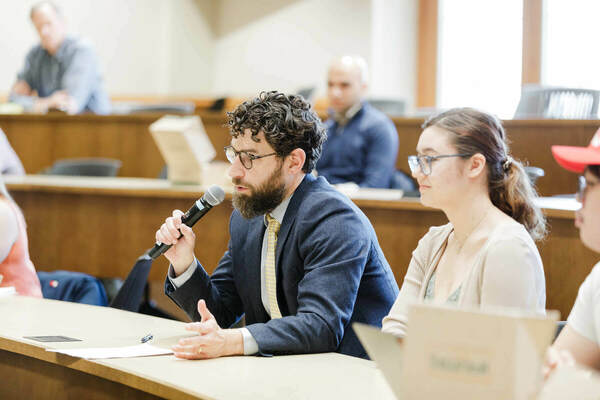
The faculty in attendance were also impressed. “Barba-Kay is one of the most insightful observers of the social and psychological effects of internet culture, and his presentation raised some incredibly important questions about the future of democracy under digital conditions,” reflected Brett Robinson, Associate Director of the McGrath Institute for Church Life. “Barba-Kay's talk,” Robinson continued, “provided an excellent framework for understanding all the ways in which that formation shapes our social, political, and even spiritual lives.”
Barba-Kay also had a chance to meet with members of the Tocqueville Fellowship during this trip. During the breakfast, the fellows engaged with Barba-Kay on specific aspects of his lecture and career. Tocqueville Fellow Jackie Nguyen (‘26) recalled that she “enjoyed the opportunity to further engage with Barba-Kay on his discussion from the previous day, especially regarding his perspective on the internet’s effects of society’s perception of reality.”
To view Barba-Kay’s remarks and browse our other recordings, visit our lecture library.