
Three Notre Dame faculty members affiliated with the Center for Citizenship and Constitutional Government were on leave last academic year to advance their respective scholarly research projects. Their work addresses a wide range of academic inquiry and offers deep engagement with fundamental questions of justice, rights, and civic virtue.
Professor Daniel Philpott, Professor of Political Science, is currently writing a book on the meaning of justice, tentatively titled Resurrecting Justice. His project challenges the dominance of the Roman law conception of justice, which is “the constant will to render another his due” by proposing a more expansive biblical vision. As he explains, “The best way to define this justice is comprehensive right relationship. It consists in part of principles that render others their due…but it also involves principles that exceed what is due such as mercy, generosity, gift, care for the poor, hospitality, reconciliation, loving one’s enemies, and peacebuilding.”
Philpott’s turn toward this broader account stems from his work in societies facing legacies of violence and injustice. Reflecting on South Africa, Rwanda, and Uganda, he recalls discovering “two paradigms for thinking about the past”: one legalistic, emphasizing punishment, and another, championed by religious leaders, that stressed reconciliation and forgiveness. His book develops this second paradigm, while incorporating insights from the first, to offer “a new way of thinking about justice” for democratic societies.
One of Philpott’s great hopes is that his book will contribute to public life. He states that there are two component principles of justice: “those that foster rights and those that exceed rights,” both of which are “important for public life.” He said, “The first kind secures dimensions of human dignity. The second kind are mostly oriented towards healing wounds, including the historical wounds of injustice. A democracy needs both. But if justice is only about rights, then the other principles such as mercy, care, and forgiveness become relegated to the margins.” Furthermore, Philpott states, “I have a notion that this wider justice may offer hope in this time of great division in the national life of the U.S.”
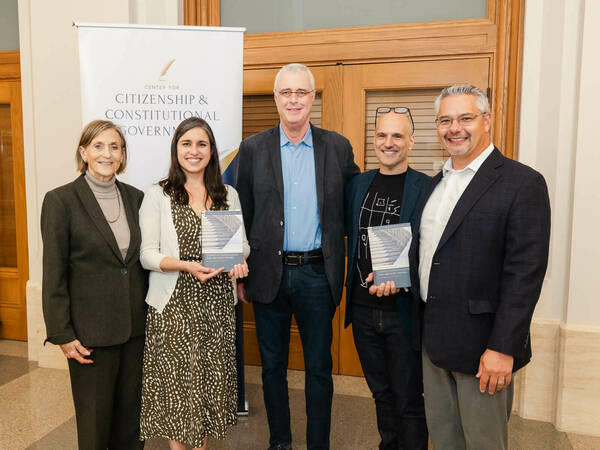
Professor Christina Bambrick, Filip Family Assistant Professor of Political Science, recently published her first book, Constitutionalizing the Private Sphere: A Comparative Inquiry (Cambridge Press 2025), which examines the constitutional duties of private actors in the United States, India, Germany, South Africa, and the European Union. She noted, “My early research focused on constitutions as unifying forces, whereas I’m now beginning to study how constitutions permit certain kinds of pluralism.” The book asks to what extent constitutional commitments apply to nonstate actors, such as corporations, associations, or other entities, and uses political theory to probe the full implications of these questions.
Bambrick emphasized the timeliness of her research. “The vast array of political questions implicating private actors today shows the importance and timeliness of my book. One of the best examples is the issue of social media regulation and Big Tech’s influence over politics more generally.” Her current projects extend this line of inquiry, exploring how nonstate law and norms, like customary law, religion, and international law, interact with state constitutions.
Professor Mary Keys, Professor of Political Science, has been examining the theme of humility in Augustine’s City of God, the subject of her book Pride, Politics, and Humility in Augustine’s City of God (Cambridge 2022). Keys explained, “Augustine’s earlier writings on humility in political, philosophic, and religious life were hugely impactful, and so merited more attention than they had previously received.” Her research traces the role of humility in civic life, particularly in dialogue with St. Thomas Aquinas, who paired humility with magnanimity as twin virtues oriented toward the common good.
During her 2024-25 academic year sabbatical at Princeton University’s Politics Department and James Madison Program, Keys expanded her work with articles and book chapters on Augustine and Aquinas. Looking ahead, she hopes this research can shape civic culture. “Humility is an antidote to hubris and a facilitator of true discourse, which involves listening to others and to the world around us.”
Together, the work of Philpott, Bambrick, and Keys demonstrates the CCCG’s distinctive contributions to political thought, which advances not only academic debates but also seeks to influence how societies understand justice, constitutionalism, and civic virtue in public life.
Learn more about the CCCG’s research and scholarship on our website.